
A client sitting across from a clinician for the first time is rarely at the same starting point as the client before them. Some have been mandated to treatment and are not yet convinced a problem exists. Others have quietly weighed the decision to change for months and are finally ready to act. Recognizing where a client stands in that process shapes nearly every clinical decision that follows.
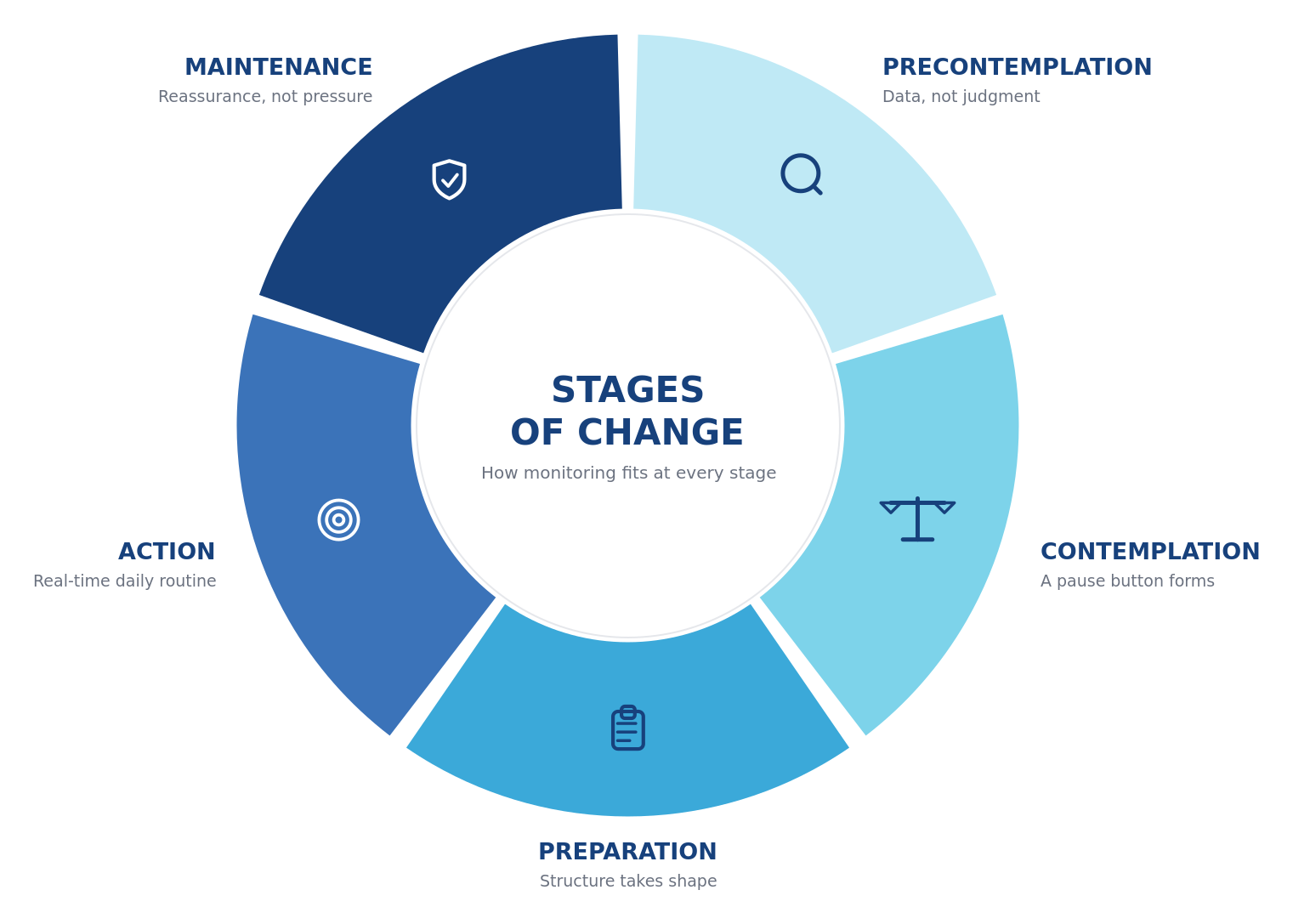
The Stages of Change model, developed by James Prochaska and Carlo DiClemente, gives clinicians a shared language for this. It describes five stages that most people move through on the way to lasting behavior change: precontemplation, contemplation, preparation, action, and maintenance. People rarely move through them in a straight line, and a client can slip back a stage before moving forward again, but the model offers a clear map of where a client is and what kind of support will actually land.
At every stage of change, an accountability monitoring tool like Soberlink can support recovery. From the earliest denial through years of sustained recovery, a clinician can calibrate how it is introduced and framed to fit the client’s needs. The chart below breaks down what that support actually looks like at each stage, before we walk through each one in more depth.
.png)
Kaila Hattis, a licensed marriage and family therapist and founder of Pacific Coast Therapy, uses the model as a starting point for nearly every clinical decision she makes. “I find the Stages of Change model useful in understanding where exactly the client is at the moment and what tools I should offer to help them achieve their desired outcome,” she said. “Listening to their concerns, finding out their level of motivation or lack thereof, fears, confidence, and willingness to change provides me with information needed to determine the best possible course of action. A client may recognize the issue and be willing to make changes, whereas another person may feel indifferent or unsure of what they need.”
Jackie Daniels, a licensed clinical social worker and Director of Clinical Development at Indiana Center for Recovery with more than 20 years of clinical practice, gets there through observation as much as conversation. “The way I use the stages model in my daily process is by listening closely to the language my clients use, looking at their body language, their general way of carrying themselves, and how they react to certain questions,” she said. “In short, I observe their behavior. All of this is done by asking specific open-ended questions. This is also the way that I assess which stage the client is in. For example, if a friend or a family member recommended that they reach out to a professional, and they don’t understand or see the problem, I know they are in the precontemplation stage.”
With the overall picture in view, it helps to look at both worksheets for each stage and then at each stage individually, including the specific role monitoring plays as a client moves through it.
Identifying a client’s stage does not have to rely on clinical intuition alone. Two brief, evidence-based worksheets can help structure that conversation and calibrate it in real time.
The Readiness Ruler, developed for use alongside motivational interviewing, asks a client to rate their importance, confidence, and readiness to change on a simple numeric scale. The resulting number, and the conversation it opens up, gives a clinician a quick read on where a client stands before deciding how to introduce monitoring.
The Stages of Change Self-Assessment, based on the University of Rhode Island Change Assessment, offers a more structured look across precontemplation, contemplation, action, and maintenance. Used at intake or at key transition points, it can confirm what a clinician is already sensing, or surface a stage the client has not put into words yet.
Both tools work best as a starting point for conversation rather than a final score. Used that way, they give clinicians a repeatable method for deciding not just whether to bring monitoring into a treatment plan, but how to introduce it in a way the client is ready to hear.
In precontemplation, a client has not yet acknowledged that a problem exists, and a tool introduced too forcefully at this stage tends to trigger resistance rather than progress. Daniels described monitoring’s role here in plain terms. “In the early stages, a lot of people are still in denial; alcohol monitoring tools help us to avoid any defensive arguments and act as a point of reference. There is no one pointing the finger; it is data and facts. It also helps them to connect the dots.”
Hattis frames it the same way. “A client’s readiness to change often determines what tools should be used,” she said. “In the early stage, monitoring can help them see whether there are any patterns that should not be a part of their life without judging or criticizing themselves for that.”
For Daniels, the goal at this stage is narrow and deliberate. “Any tool that I introduce here is not to play police officer; I am not there to catch them out,” she said. “What I want is data; at this stage I am not trying to force them to follow a routine, it is purely to gather data.”
As a client moves into contemplation and preparation, ambivalence is still present, but the conversation starts to shift toward what change would actually require. “During the stage of change, structure and consistency might be challenging but necessary to overcome the addiction or unhealthy habit,” Hattis said.
Daniels sees this transition as the moment monitoring earns its keep. “In the transition stages, where the client has decided to address the situation, these tools help to create a ‘pause button,’” she said. “Usually, during this stage, there are intense cravings, and making the right decision can become difficult. Having a tool that keeps track of what you are doing helps the client not give in to the cravings. They know that if they give in, it will show in the data. It also boosts confidence during the transition stages; in the early stages of recovery, it can feel unrewarding. But being able to track their progression, and submitting clean test after clean test, helps them to remain committed. The best way to think of it, is like receiving a tiny reward, for all the effort they put in.”
By the action stage, the client has committed to change, and the risk shifts from ambivalence to relapse. Monitoring’s role shifts with it. “At the action stage, any tool that is used begins to form part of a daily routine,” Daniels said. “The reason for this is that at this stage a relapse is possible or possibly falling back to one of the previous stages. The tool is then used to provide real-time data and as a way to make their choices easier.”
Hattis is careful to draw a line between accountability and pressure here. “The most effective tools are chosen based on the readiness of the client to change because they will be more receptive and responsive to some actions than others,” she said. “Being accountable is always a helpful and empowering exercise, but it should never be punishing. The ultimate goal is to remind the client of their ability to be in control of their life and overcome challenges they encounter.”
In maintenance, the work looks different again. “When monitoring becomes a regular occurrence, it should serve as a reminder and reassurance that the person is on the right track rather than a tool to put pressure on themselves,” Hattis said.
Daniels sees this stage as where monitoring stops being about the substance at all. “In recovery, it is no longer used to monitor or to battle craving,” she said. “Instead, it is used to help clients in other aspects of their lives. For instance, repairing broken relationships. Often, the people around them are hesitant to take their word; these tools offer proof of their sobriety. Once fully recovered, it also takes effort to remain committed. And slips can happen; these tools allow support teams to act quickly, ensuring that the client does not spiral completely. It also provides the client with a record of their success. For them, looking back on years of clean test results, can help them to stay confident and committed.”
For many clients, especially those repairing relationships damaged by active addiction, the value of monitoring has as much to do with trust as it does with sobriety itself. “I think that accountability tools can be beneficial in rebuilding trust as they can demonstrate consistency to those that you are accountable to,” Hattis said. “You can not simply talk your way into regaining lost trust, as trust that has been lost requires actions of consistency to be rebuilt.”
She is careful to frame the tool itself as a means, not an end. “As these accountability tools are a means to an end, they should be looked at as something that can help in rebuilding trust, something that can help reduce fears, something that can help foster transparency, and something that can help put a person in recovery back in control of their sobriety,” she said. “Rebuilding trust should happen over a period of time and should be done through many micro steps that demonstrate honesty. This could come in a number of forms, including but not limited to tools of accountability.”
Across both clinicians, the same caution surfaces. Monitoring only works when it fits the person using it, not the other way around. “My advice to others is when you go with a one-size-fits-all approach you can end up with a client that fights back,” Daniels said. “We are there to guide them on their path to recovery, not to control them on it.”
This is the same flexibility that a remote monitoring platform like Soberlink is designed to support. A tool that pairs facial recognition for identity confirmation with real-time breath alcohol results and cloud-based reporting can function as pure data collection in the early stages, as a daily accountability structure during the action stage, and as periodic reassurance once a client reaches maintenance. The scheduling and reporting stay consistent. What changes is how the clinician frames the data and what it is being used to support. Many Clients also express that sharing their results with family and friends gives them a concrete way to demonstrate sobriety and rebuild trust with the people who matter most to them.
Clinicians who want a closer look at how remote monitoring can be built into a stage-aware treatment plan can explore Soberlink’s free clinical training resources for practical guidance on integrating accountability tools across the full arc of recovery.
Explore Soberlink’s free addiction training resources