One of the many challenges parents face is ensuring their children’s safety, stability, and well-being after a divorce, particularly when child custody becomes an issue. Child custody can be a contentious issue with a whirlwind of pain and difficulty in even the most amicable divorce. The problem worsens when alcoholism is involved, further compounding the distress.
When a parent struggles with alcoholism, their ability to make sound judgments may be impaired, putting the children at risk. And the effects can be wide-ranging. Children can develop serious attachment issues and struggle to form healthy relationships with peers or authority figures, experiencing increased hostility or fear. They may also exhibit impulsive or aggressive behavior or have trouble with social skills.
But there is hope. Parents can rebuild their lives and their children's lives, even when alcohol abuse is a factor in a child custody case.
Generally, alcohol abuse in child custody cases manifests in one of three ways:
The parent alleged to be an alcoholic may risk losing custody of their children. Although evidence of struggles with alcohol does not necessarily mean that a parent will lose custody of their children.
In making custody-related decisions, a Court may consider whether an alcohol abuse issue exists – to begin with. The Court may then review whether that parent’s alcoholism will negatively impact that parent’s ability to care for the children.

The overarching goal of Family Law is to ensure the safety of children but absent an imminent threat to the child, there is also a strong preference to keep the parent in the child's life.
When one parent abuses alcohol, it may be impossible to determine the best course of action for the children. This determination can be a tricky balancing act for the Court but made easier with a remote alcohol monitoring technology like Soberlink.
This technology bridges the gap between the children's best interests and the parent's desire to have a meaningful relationship with their children. Moreover, these tests simultaneously calm the fears of the parent who believes that their former spouse’s alcohol consumption presents a danger to the little ones. The Concerned Party can enjoy peace of mind knowing that the children are not in harm’s way.
Resolution of any of the above circumstances raises several questions that are likely to pose obstacles in a custody and alcohol case:

Proving alcohol abuse in a child custody case may be less of a burden if (a) there is documented evidence that a parent has had recent alcohol-related incidents or arrests, (b) the person has a documented history of driving while intoxicated, or (c) the person has been ordered by a Court or mandated by an employer or other official to participate in a treatment program.
Sometimes the accused parent will address past transgressions with alcohol abuse in court proceedings and to other professionals involved in the case. They may even enter into a treatment program voluntarily, if for no other reason than to demonstrate to the Court that they are making an effort towards recovery.
In the absence of direct or documented proof of the accused party’s alcohol abuse, witness testimony or written sworn statements may be required to corroborate the allegations. The Concerned Party may also be required to gather and produce other forms of admissible evidence; however, this effort can prove time-consuming, inconvenient, and costly.
In the worst-case scenario, there is no clear-cut evidence of alcohol abuse, and it becomes a game of “he said, she said.”
As the ideal solution for all involved, some Courts will order Soberlink remote alcohol monitoring. Still, the person accused of being an alcoholic can also voluntarily agree to use the comprehensive system as a show of good faith. Soberlink allows the accused party to prove their sobriety during scheduled parenting times or daily, based on what the Court deems appropriate and the level of severity. Using scheduled testing, the accused party can test up to four times a day with results sent instantaneously to the Concerned Party.
The advantage of routine testing is that it can reflect a pattern of sobriety, and, as a result, disprove accusations of alcohol consumption during the party’s time with the children.

Soberlink uniquely combines several technologies into one handheld device. Combining a professional-grade breathalyzer with wireless connectivity, the portable design and state-of-the-art technology includes facial recognition and tamper detection and remotely delivers real-time results to designated individuals via text messages or email. It supports accountability for sobriety and also features Advanced Reporting capabilities helping parents and Family Law Practitioners to streamline litigation.
Soberlink makes it seamless for parents and Family Law Attorneys to have easily understandable test results at their fingertips.
With the transparency of identifying alcohol consumption before, during, and after the parenting time, it is not surprising that Soberlink has become the leading solution when child custody cases involve alcohol.
Thousands of Family Law Professionals have trusted this technology, and hundreds of thousands of clients have used Soberlink since its' premiere in 2011.
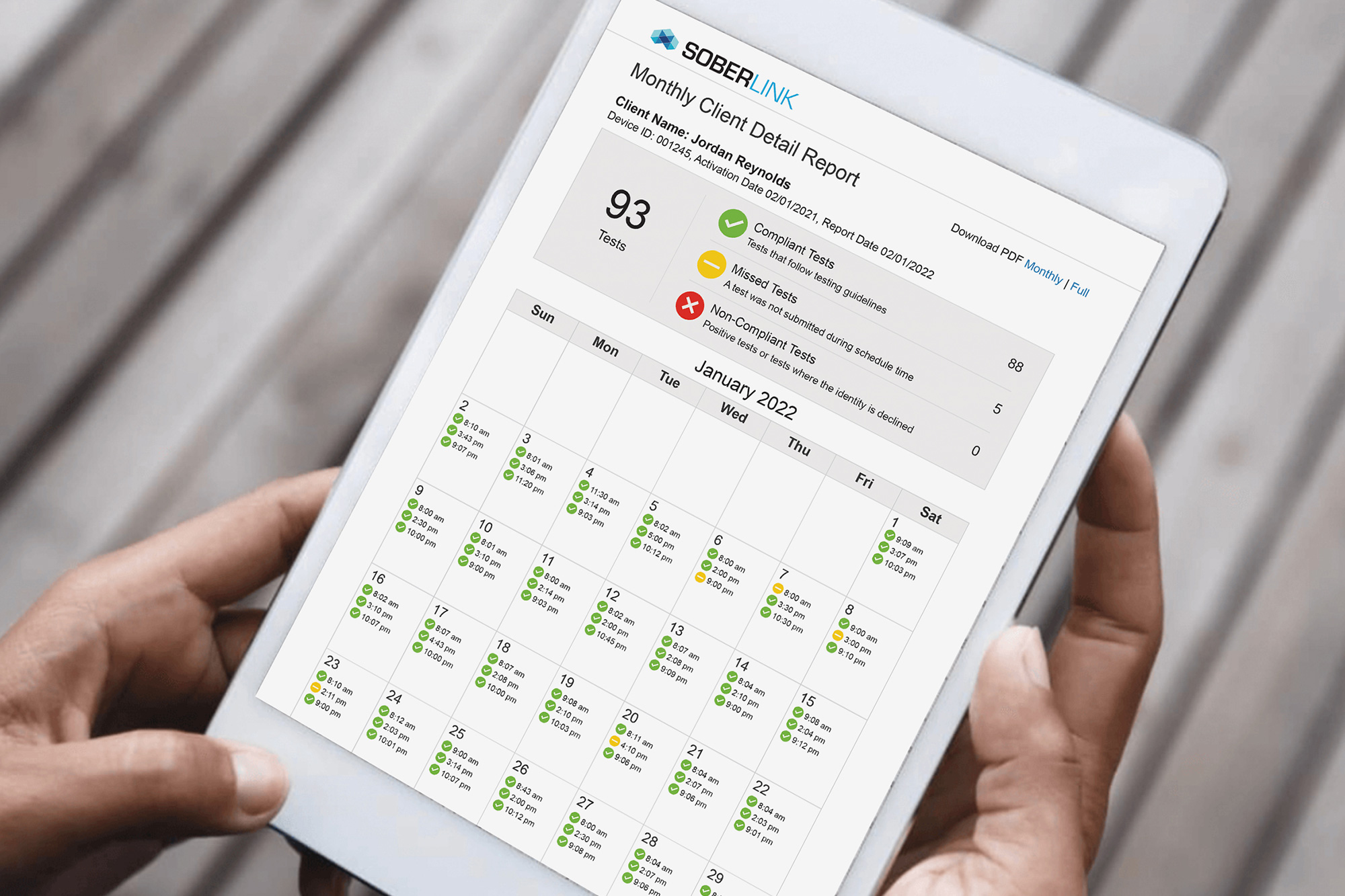
Soberlink alcohol monitoring programs in child custody cases save parents from frequent court dates and unreliable evidence that can fuel more arguments, adversely harming their children. Relying on hearsay and witnesses who may or may not be trustworthy lengthens cases, increases costs, and rarely offers permanent closure – all strong reasons concrete, court-admissible proof is so necessary.
Family Law Attorney Gregory Forman says, “The cases in which the Court does not require such a choice will often lead to endless litigation. How much simpler it would be if the Family Court uniformly implemented this solution.”
Soberlink is the Number 1 alcohol monitoring system used in Family Law cases for good reason. It has repeatedly proven its value in courts across the nation as a reliable and impartial system for recording drinking events and demonstrating sobriety.
Soberlink welcomes a dialogue with Concerned Parties, the accused, and legal professionals to explore its robust, foolproof, and life-changing technology. Reach out for informed advice on how to improve lives while safeguarding the most vulnerable among us.